Archive
Copyright laws and piracy
You wouldn’t steal a car.
You wouldn’t steal a handbag.
You wouldn’t steal a television.
You wouldn’t steal a DVD.
So, you wouldn’t download. Would you?
Photographs, software, films and music are the highest leaked items on the world-wide web. So where do you stand?
Only a few weeks ago the recurring problem of copyright laws and piracy was brought to our attention with 36 minutes of the new Harry Potter and the Deathly Hallows film being leaked.
Some people feel laws need to be harsher to stop infringement of copy right laws and the government need to put more money, energy and effort into combating privacy. Countries, such as Sweden are currently dealing with law breakers and demanding they pay the ‘damages to the entertainment industry’ rather than serving prison sentences. Would this punishment in the UK be effective?
However, other people feel that information should be freely available to all. They feel that it causes no harm sharing files and as long as no one is making ‘profit’, the acts they commit should not be deemed as illegal. In the instance of music, some internet users claim that downloading helps the discovery of new bands and artists, that would not normally be listened to if money was involved. It has been mentioned before that companies/artists leak their own material as they are fully aware how big the ‘downloading market’ is and this promotion works in their favour.
Though in such a big market and media based world where do you find yourself standing? Morals I feel play a big role in copyright laws and piracy. Do those who simply click a button to download a harmless Christmas carol really know what laws they are breaking? Do you?
The government is currently dealing with the recession in England and also the money troubles in Ireland. However, perhaps time and effort should be allocated to tackling privacy issues. Our red notes should target the red spread of illegal downloading across the Web. On the governments fence, perhaps the man power and resources required to overcome such a large medium and scope would be too expensive. Now that would really hit the economy. The campaign to stop downloading online went to the labour party conference in September 2009 and since then there has been little mention of the problem. Now is the time to turn the ignition and get the drive going to combat downloading.
The Industry Trust a campaign that has been running since 2004 helps promote copyright laws. Perhaps the use of a positive campaign steering away from highlighting what is illegal downloading and making people realise the benefit of copyright laws is the right direction and approach to take. Downloading has a massive impact of the creative industry: publishing, audio, television, radio, films and so forth. Action needs to be taken to prevent illegal downloading and to ensure jobs in these industries remain.
Changes need to happen. Suggested is harsher laws for those who download illegally. Money invested into promoting the benefits of copyright laws in the first place and finally more awareness and information provided to individuals who are unsure about illegal downloading. With these small but steady improvements the cogs can start turning and tackling piracy can begin. In the hope that one day the conversations such as, “Oh, I watched it online already,” will cease to remain.
Share this information with:

Fashionable Google
Last week Google launched www.boutiques.com in New York. Google introduced the virtual shopping centre website tailored to fit any customer. The website will only ship to customers in America however boutiques.com have expressed the desire to expand and bring the ‘new’ shopping experience to the UK.
The website offers a good range of women’s fashion (lines for men coming soon): shoes, clothes, bags, accessories and designer looks. The USP of the website is focused on you (the customer). The registration seeks to determine your personal style and preferences. Six questions aim to direct you to the most personalised shopping experience.
The website is easy to use offering users the chance to explore fashion to their heart’s content. Users can browse, save, add favourites, see recommendations and filter choices specifically to personal choice.
For many alert viewers you may notice Google cannot be seen on the website but as discussed by ‘The Next Web‘ article the visual search technology stems from Google’s acquisition of the website Like for an estimated $100 million.
So is this a fashion crisis for Google?
Previous Google post on my blog…
Share this information with:
Morality on the internet (revisited)
I published the article morality on the internet on 11th November 2010. To say I was surprised at the feedback and viewings I received over the days that followed, is an understatement. I was overwhelmed, (happily), with over three thousand people reading my article in two days. The article proved to be thought-provoking and topical, but also uniting people. This could be due to the fact censorship affects everyone (using the internet) in one way or another.
My blog post was featured on the WordPress home page for a couple of days:
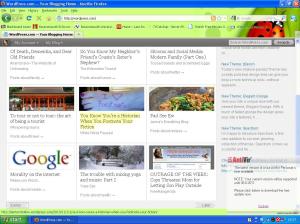
My blog featured on the homepage of WordPress, 11-13 November 2010
I received numerous comments on my article, for and against. Then I paused to stop and think. What is my blogs intention?
This blog is (worth) one unit in my university degree (second year) out of a total of six units. The project (assignment) is to create a website displaying my work, opinions and ability to communicate in a socially (internet) dominated world. So in my blog world, did I want comments from other people containing expletives? Anger towards myself (the author) of my piece of writing? Censorship. This sudden arousal of thoughts made me stop in my tracks. From this personal thought and experience meant I could empathise with both sides of the ‘Morality on the internet’ discussion.
To provide more depth and breadth on how other blog users dealt with commenting upon articles I went to the well-known and trusted website of the BBC. The House Rules for blogs on the BBC offer guidance to readers on what they can write in response to an article.
Digressing slightly from the previous paragraph, I found it interesting to remember and note the ‘old’ censorship news over the last few years, Google use- banned in China back in 2002, and you may remember the lecturer banning students from using Google and Wikipedia, 2008. One of several reasons for these actions being taken could be the freedom and exposure these websites offered to people. Students could be reading facts that were potentially incorrect or ill-informed and using these in their studies. China, a larger scale example than the latter, but sharing the same goal, trying to gain control (through censorship).
So where does this leave me to conclude? Well in fact it doesn’t. Having experienced ‘a mild form of censorship’ since posting my original article, I think it is important to recognise perhaps websites need to initially set guidelines and a visible statement of what they offer so that users clearly know what they are getting and these are set in stone. As websites may, as proved above, be restricted to certain users in the future. Censorship should be recognisable on an internet website and users should be given access to this knowledge. Then users will know how the website is constructed and how it will respond and fulfil a users demand. For example, how a website would react to a search for “anything“.
It may be considered a contradiction that I have created my own house rules for my blog but this has led me to draw points to help form a conclusion from my previous article. Censorship offers control, and perhaps in certain situations control is needed. However, users should be fully aware if their content has been restricted or reduced. If I had not seen the Google censorship article, potentially, as a (passive) user searching for suicide I would have overlooked the first result of the search, the help line. I would have been none the wiser about the censorship.
Therefore if censorship is to be appreciated and in some ways, understood, amongst the public, it has to be defined and explained fully when, why and where it is happening or otherwise users can feel cheated, disappointed and lose trust in a society or organisation. This can also give users more choice. A user can decide whether they want to be in a controlled environment or not. It opens the possibility to a clearer distinction and less friction being caused.
Up until this point I have not had the chance to experience or appreciate censorship, however, since, being exposed to the choice on whether to approve comments upon my page, I had the power of censoring. So should we be knowledgable of when censorship occurs? Will this help? Will we ever truly know all?
House rules for Rebecca’s World
House rules are to ensure my blog is respected and enjoyed by all users.
I reserve the right to deny comments to my articles or blog that:
- Contain swear words or other loaded language that could or is likely to cause offence
- Are considered abusive, sexist, sexually explicit, homophobic or racist
- Are not concerning or relating to the article or blog (off-topic)
- Are containing direct and personal contact details
- Are breaking the law or condoning unlawful behaviour
Please offer your opinions to my follow-up article as I would be extremely grateful. How does your blog operate?
Share this information with:


 Rebecca's Rambles...
Recent Comments