Archive
Harry Potter and the Deathly Hallows: Part One
*** Please do not read if you want to watch the film (spoiler) ***
I have just got back from watching Harry Potter and the Deathly Hallows and I need to write a review.
The two and a half hour film has been long-awaited and the cinema attendance reflected this with all the seats filled. Everyone was eagerly sitting on the edge of their seats, screeching at glimpses of Harry Potter and the tension building as the advertisements came to a close.
The film instantly reminds us of the “dark” end we were left with in Harry Potter and the Half-Blood Prince. From beginning to end, the film focuses on the three main characters: Harry, Ron and Hermione. Voldemort is also given a larger role in this film and viewers are able to understand his impact on the magical world since the Half-Blood Prince. Voldemort is terrifying and does not fail to create further misery. With a world in ruins and a corrupt Ministry of Magic the trio must work together to combat the dark lord and his many followers.
The majority of the film follows the journey of the three characters trying to find and destroy horcruxes (pieces of Voldemort’s soul). After disguising themselves as members of the Ministry of Magic the trio retrieve one horcruxe. From then on the horcruxe’s power is emphasised. It is highly influential on the characters morals, attitudes and feelings, and similarly to the ring in Lord of the Rings, they each take it in turn to wear the “necklace”, (to reduce its power and control). The film frequently uses panoramic views and long shots to show the vast land surrounding the three characters and the feel of a “quest”. The majority of the scenes are filmed in a woodland (camping) and creates yet again, similar images seen in Lord of the Rings.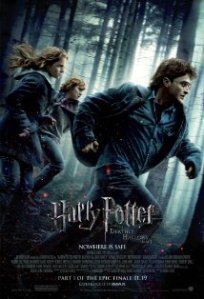
For a 12A I found a few scenes uncomfortable and I wondered whether the rating was really appropriate. A scene with Ron trying to destroy the horcruxe results in the evil force trying to control his mind and thoughts. The evil force takes the shape and form of Harry and Hermione, his two best friends, kissing and caressing. A very intimate and saucy scene. Hermione being tortured represented through the use of audio (cries of pain). I considered this film in comparison to the whole series to be the scariest yet, was this the director’s intention?
The subject of Harry and Hermoine’s relationship continues throughout the film and almost takes away the magic from Harry Potter. The magic missing is ‘the element of surprise’ and the ability to captivate and entertain the audience. The use of familiar characters we haven’t seen in a while, such as Dobby, makes you remember why you fell in love with the Harry Potter films. However, the films slow pace and sadness is not necessarily what we all expected. With a few laughs, tears and gasps, the film does leave you (the viewer) wanting to watch the next instalment. July 2010.
Overall I award this film with 6.5/10 – as it offered a cauldron full of excitement, adventure and quest but it was missing the magic ingredient to create a mind-blowing potion.
Questions to possibly ask:
Did this film really need to be made into two parts?
Did you get distracted by the love triangle?
What rating would you give it?
Share this information with:

England vs. France
Millions of England fans tuned in last night to watch England lose 2-1 to France at Wembley stadium. The last game of the year, so what went wrong?
France started the better team from the moment the whistle blew. After 16 minutes France took a well-deserved lead. Benzema took his opportunity in the penalty area, with help from Florent Malouda, and directed the ball with force to the bottom corner.
France had a very dynamic midfield arrangement and throughout the match Henderson and Gareth Berry England’s midfield duo had a difficult time claiming position. France’s second goal came only ten minutes after the second half.
However, England continuously tried to keep the stamina and pace going but France ultimately played 90 minutes of good possession, arrangement and drive. Steven Gerrard limped off the pitch, 85th minute, with his hamstring injury. This decision was defended by England manager Fabio Capello.
Peter Crouch’s goal did not go unnoticed and caused excitement amongst England fans; however it was a little too late for the England squad.
Fabio Capello said, (BBC interview): “It was important that some of the young players played at Wembley against a really good team, important for the future,”
The question we all want to know, what line-up will Capello surprise us with next?
SCORING SUMMARY
FRA – Karim Benzema (Florent Malouda) 16’
FRA – Mathieu Valbuena (Bacary Sagna) 55’
ENG – Peter Crouch (Ashley Young) 86’
LINEUPS
ENG – Foster, Jagielka, Gibbs (Warnock 72), Ferdinand (Richards 46), Lescott, Gerrard (Crouch 84), Walcott (A Johnson 46), Henderson, Barry (Young 46), Milner, Carroll (Bothroyd 72).
FRA – Lloris, Sagna (Reveillere 86), Rami, Mexes (Sakho 46), Abidal, Gourcuff (Hoarau 85), Nasri, Malouda (Payet 77), M’Vila, Benzema (Remy 67), Valbuena (Diarra 68).
See Yahoo’s coverage of the game
Share this information with:

FAQ: Alcohol Vs. Heroin
Sacked government drugs adviser David Nutt publishes investigation in Lancet reopening debate on classification for alcohol.
What is the study ‘alcohol being more harmful than heroin or crack’ about?
From the breakaway Independent Scientific Committee on Drugs, the study says that if drugs were classified on the basis of the harm they do, alcohol would be class A, alongside heroin and crack cocaine.
Who has carried out the study?
The study has been led by the sacked government drugs adviser Professor David Nutt with colleagues. Professor David Nutt was Britain’s former chief drugs adviser who was sacked by the government in October 2009.
Why has the study been released now?
The study has updated and extended the 2007 ‘Development of a rational scale to assess the ham of drugs of potential misuse’ by Professor David Nutt and colleagues.
What does the study look at?
The study looks at 20 drugs in total amongst these were heroin, crack, alcohol, ecstasy and marijuana.
The study comprises of a 16-point checklist – nine factors relating to harm to the user, and seven more measuring harm to others.
- physical harm to the user
- how addictive it is
- the effect of its use on families, communities, and society
- economic costs like health care, social services, and prison
The checklist produces a score out of 100 and therefore the higher the score, the greater the danger.
What does the study’s results show?
The study shows that heroin, crack and crystal meth are deadliest to the individual user, but when their wider social effects are taken into consideration, alcohol is the most damaging, followed by heroin and crack.
Excessive drinking damages nearly all organ systems, and is also connected to higher death rates. The study shows that alcohol was related to a large percentage of crime than most other drugs, including heroin. Marijuana, ecstasy and LSD scored far lower, according to the study.
The scores of each drug (out of 100):
Alcohol (72)
Heroin (55)
Crack (54)
Crystal Meth (33)
Cocaine (27)
Tobacco (26)
Amphetamines (Speed) – (23)
Cannabis (20)
GHB (18)
Benzodiazapines (15)
Ketamine (15)
Methadone (13)
Butane (10)
Qat (9)
Ecstasy (9)
What does the study not take into consideration?
The Lancet paper does not examine the harm caused to users by taking more than one drug at a time.
Useful links
Interview with Professor David Nutt for the BBC
Daily Mail article about release of new study by Professor David Nutt
2007 Study conducted by Professor David Nutt and colleagues
All publications by Professor David Nutt
Share this information with:

 Rebecca's Rambles...
Recent Comments